
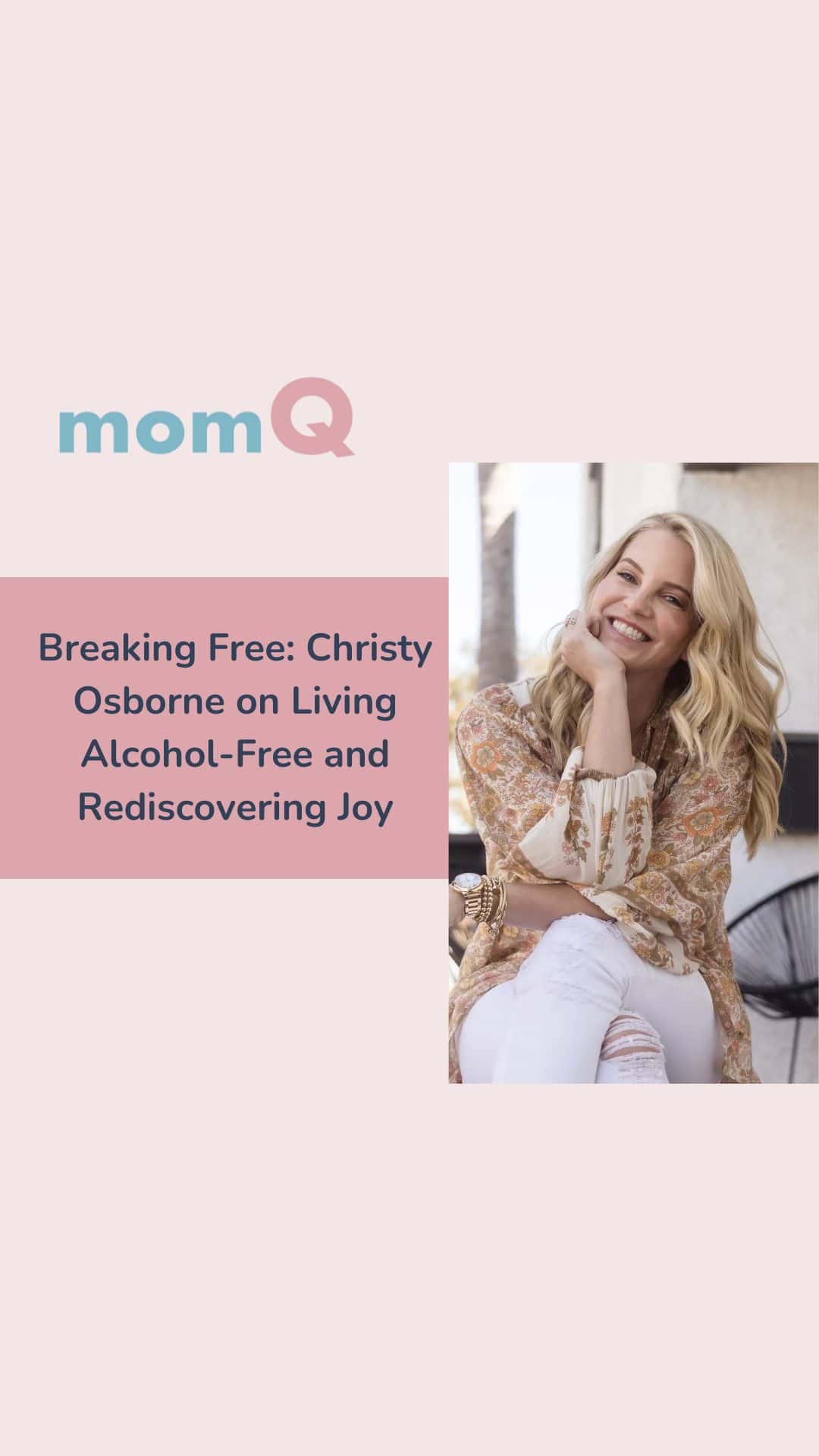
Candace Nassar (00:00.59)
Well, welcome, MomQ family. I’m excited to introduce our special guest today, Christy Osborne. Christy is here to share a powerful and timely message about her personal journey with alcohol over the past four years. And as we step into a new year filled with promises and possibilities, I believe her insights are gonna resonate deeply with many of us. And I can’t wait for you to hear her wisdom and experiences.
So welcome, Christy
Christy (00:32.048)
Thank you so much for having me. I’m so excited to chat with you today.
Candace Nassar (00:36.546)
Thank you. Me too. So before we get started, why don’t you introduce yourself to our listeners and just tell us a little bit about yourself.
Christy (00:44.699)
Yeah, sure. I’m Christy. I actually live in the UK in Surrey now, but we were in London for 16 years. I’m originally from Southern California. I live over here now in the UK with my two kids. They’re 14 and 12, and I am a double certified sobriety coach. I have a podcast,”But Jesus Drank Wine” and Other Stories That Kept Us Stuck. And my new book, Love Life Sober, a 40 Day Alcohol Fast came out this past September. So yeah, I’m excited to chat with you.
Candace Nassar (01:18.35)
Yes, and we want to hear all about it. So thanks for sharing that. So let’s go ahead and dive in. So the first thing I like to talk about on our podcast is culture versus truth, right? And so I want to start with talking about the lies that our culture believes about alcohol. What would you say to that?
Christy (01:30.277)
Mm-hmm.
Christy (01:40.067)
My gosh, I can say so many things about that, right? Yeah, well, it comes from so many different directions, right? It comes from TV, movies, but then you also have this mommy wine culture narrative that we see plastered all over social media and Etsy. And so a lot of this is driven by the big alcohol narratives that there’s a lot of.
Candace Nassar (01:42.038)
I know, I know. So it’s completely up to you, I guess.
Christy (02:07.153)
“Benefits to alcohol”. It sells us a lot of things that actually aren’t true. And so the cultural narrative comes from all directions, including our own family, our own church. And what ends up happening is that we build up this list of subconscious beliefs of how we think that alcohol is benefiting us from this cultural narrative.
Candace Nassar (02:31.95)
Mm.
Christy (02:33.775)
And so that’s what I’m trying to do, right? What we’re doing here today is like asking, “Is any of this really true or not?”
Candace Nassar (02:40.194)
Absolutely. That means, to me, that’s one of the things I’ve always heard is, you know, a glass of wine or two is good for your health. And so I want to get you to talk about that here in a little bit. but really tell us about what you’re saying, “big alcohol”. What do you mean by that?
Christy (02:58.171)
Yeah, so “big alcohol” are the large alcohol brands that run the primary industry of alcohol. And so there’s five or six of them and they are the ones that are in charge of pretty much the dominant alcohol brands across the world. And they push messages on us that the alcohol helps us connect or it helps us bond or it helps us relax or it’s this reward.
I write about in the book how I drove by a billboard when I was writing the book and it was a bunch of people in a bar, you know, cheering with alcohol and it just said, “Deserved.” Like you deserve this. And so one of the things I ask the gals that read the book to start being in tune to is what is that message? What is that benefit that they’re selling you? What is that feeling that they’re selling you? They’re actually not selling you the alcohol, they’re selling you a feeling.
Candace Nassar (03:36.964)
huh.
Christy (03:54.587)
They’re selling you something to change your state of mood or meet a need. And so when you start realizing this and seeing it, like you can’t unsee it. And then you step into this really empowered place of awareness where you realize, I’ve been duped. Yeah.
Candace Nassar (04:12.196)
Yes, yes, so true. So yeah, actually read, it’s really interesting timing that you and I are talking because recently I read an article in Christianity Today, which I’m a subscriber to and it’s called, “The Secret Sin of Mommy Juice”. Did you see that article? Yeah, and it was so interesting. It says that 9 % or 11.7 million adult women struggle with alcoholism.
Christy (04:23.942)
Mm-hmm.
Christy (04:29.721)
Mm-hmm. Yeah, I saw it. Yeah.
Candace Nassar (04:42.218)
Okay, so that’s the first one. And it does talk in there about how big alcohol has had an impact on that more and more advertisements are geared towards women. And then it also says something really interesting though, because you’ve talked about the “mommy wine culture”, it says that if you add in to those numbers 11.7 million, the women admit to being uncomfortable with their relationship with alcohol,
Christy (05:09.479)
Mm-hmm. Yeah.
Candace Nassar (05:11.812)
It’s a lot more. A lot more. So, and so that whole thing, the “mommy wine culture”, I mean, let’s talk about that. Let’s just lay it on the table. It is, it’s kind of scary.
Christy (05:13.679)
Yeah. Yeah. Yeah.
Christy (05:25.337)
Yeah. And just to go back to those stats really quick, I know they seem scary, but in a way I feel like they’re comforting, like comforting in a way because it means you’re not alone. Right. And we’ve stepped into so much more knowledge about how alcohol use disorder works. It’s no longer whether you’re either an alcoholic or you’re not. It’s a spectrum, right? And so you can be anywhere along that spectrum. And so that’s really comforting because you don’t need to have this massive rock bottom. You don’t need to declare yourself an alcoholic. You can just feel like, hey, maybe I’m not sleeping very well and I should give this another look. And so, yeah, I just think that whole, new way of thinking that it’s a spectrum is so powerful. And then yeah, to “the mommy wine juice stuff”. I mean, this is something that I fell hook, line, and sinker for because mainly it was all over social media all the time that, you know, booze is this thing that’s this great reward for being a mom. And if you are a hardworking mom, like this is the thing that you need to get through the day. And when I just stopped to think about it, obviously when I, a little bit clear from the alcohol fog of myself, I just realized that we’re sending this message to our children that they’re
really hard work and that we need an addictive drug in order to like deal with them, in order to handle them. And I know, and if you would have, if you would change that drug to anything else, right? Anything, I need cocaine, I need to smoke, I need to do some whatever in order, marijuana in order to deal with my kids, all of a sudden we’re repulsed, right?
Candace Nassar (06:49.956)
Gosh.
Christy (07:08.535)
But as you said, this is a drug that affects millions and millions of women all over the world. It’s the number three cause of preventable death in the US. And yet we’re splashing it on like baby onesies and baby bottles, now, babies want wine, I wine, WINE. And it’s just a mommy sippy cup, all this stuff. It’s like, what are we actually telling our kids that we need to be numb in order to deal with them? It’s just, yeah, it’s sad.
Candace Nassar (07:34.466)
You know, we just don’t think about it enough. And so that’s part of what we’re doing here. So your vulnerability in your book is incredible. And, I love the format. It’s 40 day devotional and you cover so many aspects of spirituality and, then as well as just encouraging and all of that.
Christy (07:39.591)
No, yeah.
Candace Nassar (07:58.053)
But you’re very vulnerable and you talk about how alcohol or your drinking affected your ability to enjoy and be present with your children when they were younger. So that’s what you’re starting. We’re starting to go there. So let’s talk about, you know, how does alcohol impact our relationships?
Christy (08:14.595)
Yeah, this is the thing, right? It just completely screws up our dopamine production and the way that we respond to it. And so this is the pleasure and the learning molecule. When we drink alcohol, we get this artificial level of dopamine that makes us feel euphoric. It lasts about 30 minutes. And then we keep trying to replicate that high. And the thing is, is that when you’re a regular drinker, like I was,if you can’t, you end up not being able to feel joy or happiness from anything except alcohol or your production at least is like dulled. And so what happened with me is I realized and again, this is like after having a very long break from alcohol, coming to this realization that I couldn’t see the joy, for example, in like my daughter’s ballet recital or my son’s soccer game or whatever.
Why wasn’t alcohol involved? I wanted alcohol to be involved to feel that that dopamine hit. And so it just really screws with the way that you experience all that God has for us, right? All of our blessings because you end up not being able to appreciate them. And then of course that has the knock on effect of relationships because you know, you end up prioritizing the drink over actual true connection.
Candace Nassar (09:38.112)
And we’re numb and we’re not listening as well. Maybe we’re not as engaged in the conversation that we think we are. Yeah, we might be relaxed, but it’s not that same kind of joy like you’re talking about the joy and connection. So matter of fact, I’m going to reference that Christianity Today article. It said, secular addiction researcher, Johann Hari famously said, “The opposite of addiction isn’t sobriety, it’s connection.”
Christy (10:06.663)
Connection. Yeah. Yeah.
Candace Nassar (10:08.002)
Yeah, and that’s what we need and that’s what we’re created for, but alcohol can get in the way of that.
Christy (10:15.299)
Yeah. And you mentioned being relaxed. And it’s so interesting because I work with gals all the time in coaching who that is why they are drinking is to relax or to take the edge off their anxiety. But now we know that alcohol spikes your adrenaline and your cortisol. And that stays elevated for seven to 10 days after. And so we think we’re relaxing again because of that very temporary dopamine hit. But what we end up doing is making everything more stressed, stressful because we’re operating from this high level of cortisol all the time. So it’s just like, you’re actually doing the opposite of what you’re trying to do. Yeah.
Candace Nassar (10:53.498)
It’s a lot.
Yes. my goodness. So true. okay. So some of our listeners may be thinking at this point, okay, maybe alcohol is more of an issue for me than I realize. Maybe it is something I need to think about my relationship with. And so you said when assessing our relationship with alcohol, it’s helpful to understand our reasons for thinking. And you give three questions to ask ourselves.
So you alluded to what, I mean, people are drinking because they’re wanting to relax. What are those three questions that can help us assess our relationship?
Christy (11:31.567)
Yeah, there are three questions that are variations on the same question. And the basis of it is why are you drinking? What is the benefit that you see in alcohol? And one of the ways that gals that I work with really like it to be phrased is what’s the job? What is the job that you are giving alcohol? Another one is what’s the unmet need, right? Like what do you actually need in that moment? Do you need connection? Do you need rest like true rest?
Candace Nassar (11:50.104)
ahead.
Christy (11:58.843)
Do you need to figure out a way to ease the anxiety? Do you need to find a way to reward yourself because you did have a hard day, right? Like what do you really need in that moment? And if you can find a way to get what you actually need or something to take care of that job in another way that’s actually going to fulfill it, sustain you, then you slowly lose the desire to drink and, what’s so interesting and incredible about all of this is that so many of these needs that we want, right? Also joy, peace, these are what we can get from God, right? This is, and that is why the alcohol is such a counterfeit, right? It’s such a bad substitute for going to the Word or going to prayer where we can actually get comfort from the comforter.
Candace Nassar (12:32.964)
Yeah.
Christy (12:48.185)
As opposed to this artificial substance that just keeps us hooked, wanting more and feeling awful the next day.
Candace Nassar (12:57.289)
Okay, so good. So that leads me straight into my next question, “How can taking our thoughts captive lead to better allow us to change our thinking of alcohol?
Christy (13:09.177)
Yeah. And this is the thing, right? It’s so great because I love how there’s so much, sober curiosity booming right now and there’s so much about it in the self-help space, right? But it’s actually all the things we really need are in the Bible, right? It is, it’s taking these thoughts captive. So just like the example we just said, “What do you need when you’re wanting that drink?” Like take those thoughts captive, write them down. Like what is the craving voice saying?
Candace Nassar (13:23.554)
Yes.
Christy (13:37.869)
And what can you hold, what is that thought? Hold it up to the truth and see what actually is true. Like is the alcohol going to help you sleep? Like that was one of the things that I really believed. I thought red wine helped me sleep at night. It wasn’t until I did tons of research on how sleep actually works and then did a break without alcohol that I realized I sleep so much better without it, right? So now I’m never gonna have the thought again, “I should have a glass of Cabernet to help me sleep”, because I busted that thought open with the truth. Yeah. And so this can be done, you know, taking the thoughts captive, not just for alcohol, but for everything, right?
Candace Nassar (14:15.31)
Yes.
Candace Nassar (14:22.552)
Right, right, because we do, everyone is so stressed and anxious today. And I think we just, we’re struggling with understanding that really the answers are in the Word, the answers are with God. And if we can just find that peace with Him, release it in prayer and surrender our struggles, our worries to knowing that He is good and that He is gonna take care of it.
Christy (14:36.679)
Mm-hmm.
Christy (14:46.693)
Yeah.
Candace Nassar (14:48.962)
that we don’t need a crutch, that we don’t need something else to boost and help us along the way. So you encourage readers to stop, I love this, stop counting glasses and instead counting your fruit. So tell us a little bit how your relationship with Jesus improved from giving up alcohol.
Christy (15:03.217)
Hmm.
Christy (15:09.561)
Yeah, I mean, so many different ways, but I remember that there was all of a sudden just like a peace that came over me. There was this incredible feeling getting into bed at night, just feeling really peaceful. Nothing bad was gonna happen. I was okay. I was safe. And then the joy came back online, how we were talking about earlier, and I was able to experience the real time little joys and blessings of life.
That’s where this idea of like, instead of getting worked up and how many glasses you’re drinking or not drinking, right? Like, how is your peace? How is your joy? How is your fruit of the spirit? Because for me, and for so many of the girls that I work with, alcohol just robs you of these, of these things. I mean, like that we’re not even going anywhere near self-control, right?
Candace Nassar (16:00.994)
Yes.
Christy (16:01.327)
You know, patience, forget it. Like when I had been drinking, you know, the next day, morning after, I wasn’t patient with the kids. I was desperate for them to get out the door so I could lay back down again. and so it’s just looking at that, or how is it getting in the way of your fruit? And then also, I mean, on a more positive note, “How can you bring those back on a break from alcohol?” And what will that feel like?
Candace Nassar (16:13.988)
you
Candace Nassar (16:28.568)
Right, yeah, so I’m imagining that when you’re wanting to drink at the end of the day, that maybe that’s a time to sit with the Word. Or you’ve got maybe some scripture verses posted around your kitchen while you’re cooking. You know, some things that are positive, that are geared towards fixing our eyes on Jesus instead of fixing our eyes on that alcohol or that drink.
Christy (16:39.687)
Mm-hmm.
Christy (16:54.543)
Yeah, yeah, a hundred percent. And there are so many great practical cravings, like tactics in the book. One of my favorites is this idea of playing the tape forward twice. And so actually playing the tape forward, what would it look like if you have the drink? And I’ll just tell you how my tape would go. If I had the drink, right? It was, I poured one and I would say I would only have one or two, but I would have three or four.
Candace Nassar (17:17.603)
Yes.
Christy (17:24.367)
I would pass out, wake up at 3 a.m. filled with shame, regret. “Why do I do this all the time?” Wake up grumpy, snap at the kids, miss the workout class, you know, and so on and so on. And then be back at the same place at five o’clock desperate for the glass because at that point I was like drinking also to relieve withdrawal. But then if I play the tape forward, not having the drink, what does that look like? Maybe I’ll sleep better. Maybe I’ll wake up feeling rested. I’ll get up and actually read the Bible because I will be up early and feeling good and I’ll do my workout and all of those things. And so if you can create the space between the craving and actually pouring the drink and ask yourself this question, what does the tape look like if I drink and what does the tape look like if I don’t have the drink? And that is one of the tactics that’s in the book amongst a lot of others that my clients just love because it’s so helpful.
Candace Nassar (18:15.064)
Right.
Candace Nassar (18:22.67)
Yeah, and why don’t you talk, I love that one, and why don’t you talk about silencing the “wine witch”.
Christy (18:28.103)
Yeah. Yeah. So along the same lines, right? Of like taking our thoughts captive, because the craving voice is related to this neural pathway in your brain that’s desperate for dopamine. It has this one track mind of like, it wants the wine. So I really like to think of that voice as a voice that is apart from me. It’s not my, it’s not my smart,like upper brain, it’s this limbic system lower, like “fight or flight moment” of, “Have the drink, it’s do or die.” And if you listen to that voice, she’s got, again, a one track mind, “Have the drink, come on, you can start tomorrow, like start in the first of the month. Thursday’s basically the weekend anyway.” You know, all of these things. And another way to look at it is like a, you know, a toddler that wants ice cream, they’ve got a one track mind, they want that ice cream and that’s a similar voice. And so if you can,
separate that voice out when she’s yelling at you, take those thoughts captive, call her the “wine witch”, call her whatever you want. I mean, I’ve had clients name their craving voice really funny things after like, know, bad teachers or like, you know, mothers-in-law they don’t like, whatever, but like, just name the voice because it’s a way of, you know, stepping into that awareness of the thoughts and the cravings, yeah.
Candace Nassar (19:45.25)
Yes, yes, absolutely. So good. And then just put perseverance and strength in Jesus. And that’s where I’m sure the prayer comes in and just growing our relationship through that. And so what are some of the things that you have seen in that space as you’re looking more towards Jesus in these times?
Christy (19:56.484)
Yeah.
Christy (20:07.195)
How do you mean?
Candace Nassar (20:08.344)
Well, so you said the fruit that has come out of it. I mean, obviously, what about relationships with your kids or your husband?
Christy (20:14.983)
Yeah, yeah. I mean, my marriage is so much stronger because we’re not like, we’re connecting not over fuzzy memories and or silly fights because they’re alcohol infused. And my desire to be with the kids, like I love hanging out with them. I find so much more joy in being with them as opposed to thinking that they’re hard work, which has just been a game changer. And then my friendships have really shifted. Like I have…
a very small group of really, and some really strong Christian gals in there, as opposed to like tons and tons of friends that you’re just meeting out at the bars and like having this kind of very surface level thing going on. So it’s definitely changed. And it just, it, makes you realize what’s important, you know, and, live intentionally and spend your time in a way that you actually want to, as opposed to like by default.
And so it’s just been the most incredible journey. Like it’s, you think, you’re just cutting out wine. Yeah, that’s great. But it ends up opening up all these incredible doors. You figure out how to express boundaries and how to stick to them and all of this amazing stuff that comes. Yeah, it’s so rich.
Candace Nassar (21:31.428)
Gosh, that is so rich. I love it. And then just continuing to look to Jesus for strength and look at the positives and the results that you’re seeing. And so how has gratitude played a role in your journey?
Christy (21:50.629)
Yeah, such a big part. I think when you’re drinking regularly and you’re feeling fuzzy, you don’t take the time, first of all, to recognize what you’re grateful for. And when you switch into this mode of starting to realize all the blessings that are around you and everything that you have, gives you less of a reason to want to numb out or escape, right?
You feel like you want to be more present to actually feel and absorb all these blessings and things that you’re grateful for. And so it’s something I write about in the book as a really good thing to add on to either a morning, you know, morning routine or evening routine. when you would be drinking, like bookend your days, right? Start with the Word, end with a journal or something like that.
Keep yourself anchored into your blessings and what you’re grateful for. And I also think you’re able to see things because you’re just more clear headed, right? So you’re able to see even more blessings, right? Like I’m breathing today. You know, I have a roof over my head. You know, these small things that we take for granted.
Candace Nassar (22:57.838)
Yes.
Candace Nassar (23:03.618)
I can see when, you know, I might have that craving at five o’clock, six o’clock. If I can even just make a list of a couple of things I’m grateful for to relax, right? We think then that whole relaxing lie. But, you know, just that reminder that God is taking care of us. He’s providing and He is good. And He has always taken care of the big things and the little things.
Christy (23:16.315)
Yeah.
Christy (23:24.444)
Mm-hmm.
Candace Nassar (23:33.688)
We don’t have to worry and stress. So what would you encourage moms, a mom that is struggling, really struggling right now with this whole concept and maybe wanting to lean into sobriety 40 days, the fast that you have or even more than that, what would you say to her? That she’s afraid.
Christy (23:56.443)
Yeah, first of all, yeah, and I totally feel that. And sometimes when I’m on these podcasts now and I’m like rattling off these facts or talking about “mommy wine culture”, like I still do remember how that feels to be really stuck and feel really, really alone. I did not have one girlfriend that didn’t drink. And so I was really scared and I thought I wasn’t gonna have a social life.
I thought that everything would be boring. I thought life was gonna lose its color. All of these things. I had all these assumptions about what being a non-drinker would be like without ever having tried it. And so I would say to her, first of all, you’re not alone. You are not alone. Get plugged into a community. There are so many incredible women that are feeling exactly, exactly how you are feeling right now.
And that you don’t have to put this big goal of being sober forever or even if even a 40 days sounds scary, that’s okay. That’s okay. The first step is just becoming aware and starting to be curious about this stuff. Go into an experiment mode. Try a couple days. See what it feels like. See what your body is really telling you that it needs.
Candace Nassar (25:13.828)
Mm.
Christy (25:15.653)
Dive into the Word, see what the Holy Spirit is telling you when you ask him about this. But you’re not alone and you don’t have to start gung-ho with a massive, even a 40 day, goal. Again, it can be just like, I’m going to try two days or I’m going to start to get curious or I’m going to start to learn a little bit more about alcohol, how alcohol affects the brain and the body. I’m going to become aware of those reasons I’m drinking and seeing if it actually accomplishes
Candace Nassar (25:39.128)
Okay.
Christy (25:45.201)
those goals that I think that it’s doing.
Candace Nassar (25:48.184)
Yeah, and I love in the book you talked about those growth opportunities, which I thought was really freeing and really good. That you talk about you get started on it and then you maybe slip up and have, you know, a day where you decide you can’t handle it and you drink and then you call it a growth opportunity. Can you tell us a little bit about that?
Christy (26:06.475)
Yes, my gosh, this happened this week a couple different times in our community. And I was just like, so excited that gals would get on the call and they would say, so I went like a week and then I had a glass of wine and I realized that it actually doesn’t make me feel as good as I thought it made me feel. Or another gal said something to the effect of like, I woke up and realized even one glass, I’m not sleeping properly.
It’s this idea of like, you can still be drinking and still be learning and still be growing from this. If you are coming to it from this experimental mindset, no judgment. One of the biggest things that keeps us stuck is shame, right? Shame keeps us in the lower part of our brain. We don’t like it there. And we know a very easy way to exit that part of our brain is alcohol. So we end up drinking more. We get stuck in this shame spiral.
But if you can step out of shame and into grace and self-compassion, there’s no condemnation in Christ Jesus, right? He’s forgiven you. He wants you to figure this out and he wants you to turn to Him. And so you don’t have to do this alone.
Candace Nassar (27:18.34)
Mm-hmm. That’s so good. I love the growth opportunities and just it’s a journey. It’s a journey and that’s and it’s just like our faith journey, you know, we’re gonna slip up sometimes maybe, but that doesn’t mean that we don’t confess, repent, and keep going. So very, very encouraging. Well, Christy, this has been great. I’ve been encouraged to get some great insight. I really appreciate your time.
Christy (27:23.695)
Yeah, yes.
Christy (27:28.583)
100%.
Christy (27:34.927)
Yeah. Yeah. Yeah.
Candace Nassar (27:46.969)
I’m just excited that our readers have gotten, our listeners have gotten to hear from you and I wish you all the best.
Christy (27:55.575)
Thanks Candace. I appreciate it. Thank you so much.
Candace Nassar (27:58.902)
Okay, you got it.